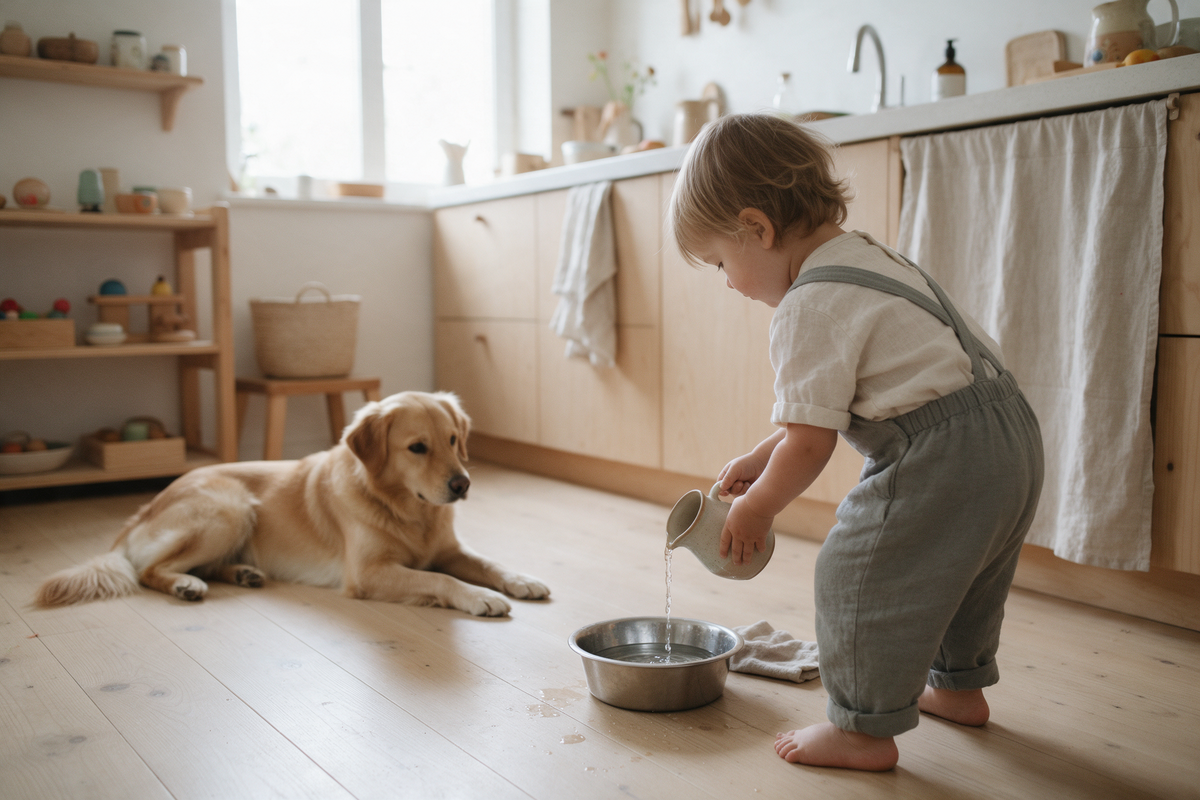
In short: Toddlers can take a real part in caring for the family dog. Filling the water bowl, scooping the daily food, brushing and walking together are practical life tasks in the truest Montessori sense. Matched to age and done with an adult close by, they build responsibility, care and a quiet kind of empathy.
Why caring for a dog is practical life
Caring for a dog is practical life because it is real work with a real purpose. Maria Montessori saw that children long to take part in the everyday tasks they watch adults do, and few tasks are as visible, or as loved, as looking after the dog.
A toddler who fills the water bowl is pouring, carrying and judging when to stop. A toddler who brushes the dog is learning gentle hands. None of it is pretend. The dog really does drink the water, and the child sees it.
Five ways a toddler can help
Filling the water bowl
The water bowl is the best first job, because it is simple, daily and easy to see. Use a small jug your child can carry with two hands, and fill it only halfway. Spills will happen. Keep a cloth nearby and let wiping up be part of the task, just as it would be at the table.
Measuring the food with a scoop
Measuring the food teaches a child that care has an exact amount. Show them the scoop, how full it should be, and how to level it with a finger. "One scoop in the morning, one in the evening" is a rhythm a two-year-old can follow and a three-year-old can remind you about.
Food is something we think about a lot at home. As a family we also run Kin Supplements, a small Swedish brand for dogs' tummies, so the morning scoop is a familiar ritual in our own kitchen too. Let your child pour the food into the bowl, then let an adult set the bowl down. Wash hands together afterwards.
Brushing
Brushing teaches gentle, slow movements, and most dogs enjoy it. Choose a soft brush that fits a small hand and show the direction of the fur. Brush together for a minute or two while the dog is calm and lying down. Stop while it is still pleasant for both of them.
Coming along on the walk
A walk gives a toddler a job and a routine to look forward to. A young child can carry the lead to the door, help put the poo bags in a pocket, or hold a second, loose lead alongside yours. The adult always holds the lead that matters.
Reading the dog's signals
Reading signals is the most important skill of all, and it can start early. Name what you see together: "His tail is wagging and his body is soft, he is happy." "He has turned his head away and licked his lips, he needs a break." Children are wonderful observers when we give them the words.
Tasks by age
The right task depends less on the child's age than on their hands and attention, but this is a good starting point:
| Age | Tasks | What it builds |
|---|---|---|
| Around 18 months | Fetching the lead, putting a toy in the dog's basket, watching and naming the dog's moods with you | Belonging, early vocabulary |
| 2 years | Filling the water bowl with a small jug, pouring the measured scoop into the bowl, brushing with you | Pouring, coordination, gentle hands |
| 3 years and up | Levelling the scoop, remembering feeding times, holding a second lead on walks, noticing when the dog needs space | Responsibility, sequencing, empathy |
Safety around children and dogs
A toddler and a dog should never be left alone together, even for a moment and even with the gentlest family dog. Most bites to young children come from a dog they know, at home, often when the dog felt it had no way out.
- Let the dog eat in peace. Your child helps prepare the food, and an adult puts the bowl down. No one goes near a dog that is eating or chewing.
- Respect the dog's own place. A bed or crate is the dog's quiet corner. Children do not follow the dog there.
- No hugging, no climbing. Toddlers show love with their whole body. Teach a flat, gentle hand on the dog's side instead.
- Watch for signs of stress. Yawning, lip licking, turning away, freezing or showing the whites of the eyes all mean "please stop".
- Wash hands after feeding, brushing and walks.
When the dog wants to be left alone
When the dog walks away, the answer is to let it go. This is often the hardest part for a toddler, and one of the most valuable lessons. You can say: "Bella has gone to her bed. That means she wants to rest. We can say hello later."
Learning that another living being has its own wishes, and that those wishes count, is the beginning of empathy. A child who learns this with a dog takes it with them to the playground, to siblings and to friends.
How the routine builds responsibility and empathy
A daily routine turns a nice moment into real responsibility. When the water bowl is always filled after breakfast, the task becomes your child's own. Soon they notice the empty bowl before you do.
That small moment, a child looking at the dog and thinking about what it needs, is exactly what Montessori meant by caring for the environment. It is the same instinct we see in the kitchen, which we wrote about in cooking with toddlers. It will be slower and a little wetter around the water bowl. And it may become one of the first things your child is truly proud of.
Frequently asked questions
At what age can a toddler help with the family dog?
From around 18 months, a child can fetch the lead, put away the dog's toys and watch the dog with you. By two, most children can fill the water bowl and pour a measured scoop of food, always with an adult close by.
Can my toddler feed the dog on their own?
Your toddler can measure and pour the food, but an adult should put the bowl down and keep children away while the dog eats. Many dogs guard their food, even gentle ones.
How do I teach my child to read a dog's body language?
Name what you see, every day. A soft body and wagging tail mean happy. Yawning, lip licking, turning away or freezing mean the dog needs a break.
Should a toddler ever be alone with a dog?
No. Even a calm, familiar dog and a careful child should always have an adult present. Most dog bites to young children happen at home with a dog the family knows.
What if my child wants to hug the dog all the time?
Show a gentler way to say hello: a flat hand stroking the dog's side or chest. Explain that dogs do not enjoy hugs the way people do, and praise the gentle touch when you see it.
With love from the Montessori Toddlers team 💛