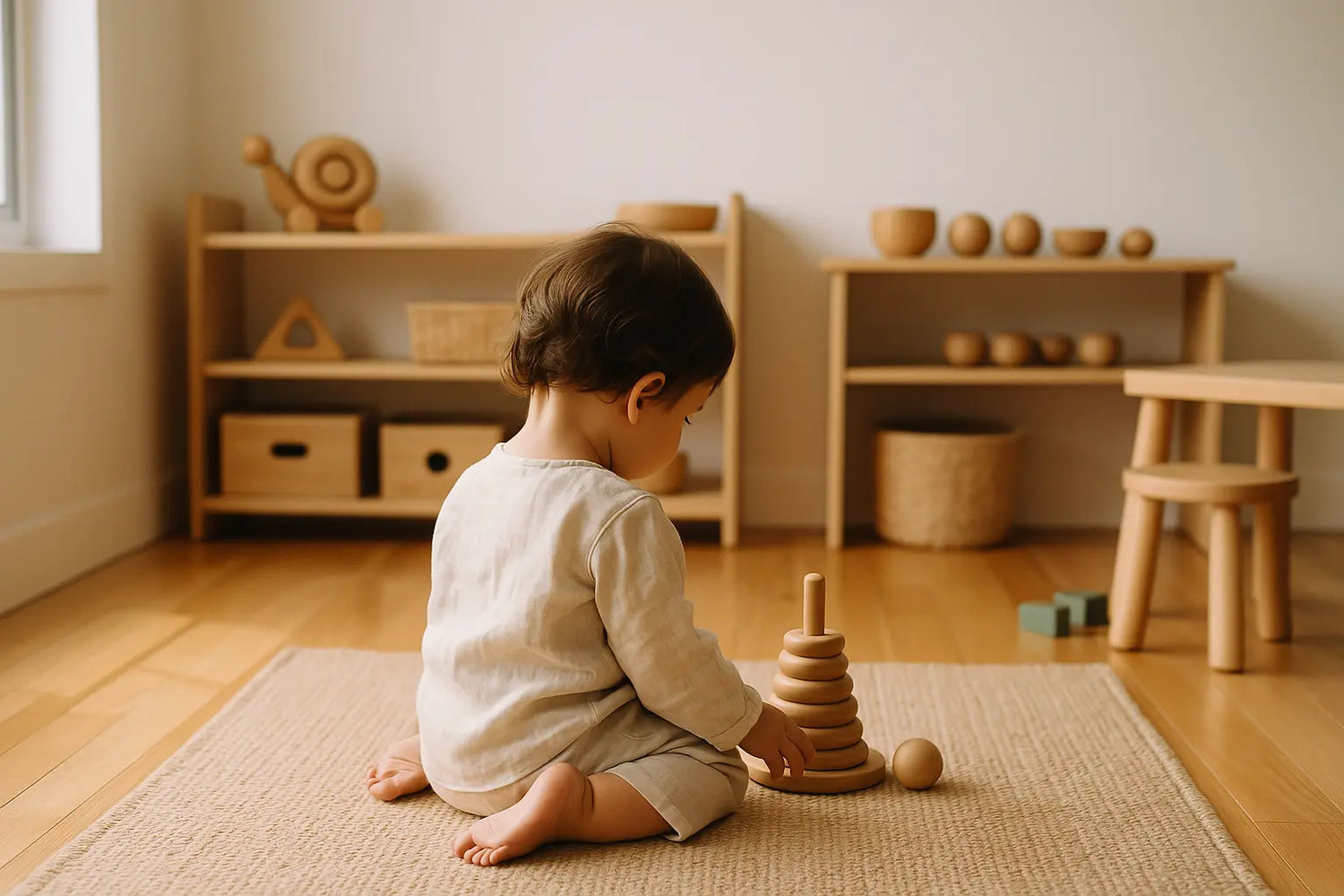
The best wooden Montessori toys for toddlers are the simple ones: open-ended, beautifully made, and designed to let your child lead the play rather than perform for them. At Montessori Toddlers we have a quiet rule that the best toys do less so your child can do more, and every pick below earns its place on a low shelf by that measure.
Wood matters here for more than looks. A wooden toy has a little weight and warmth in the hand, it does not blink or beep or make decisions for your child, and it tends to last long enough to be passed to a younger sibling. Below are eight wooden picks from our Montessori Wooden Toys collection, arranged roughly from the youngest hands to the oldest, with what each one develops and the ages it suits best.
What are the best wooden Montessori toys?
The best wooden Montessori toys are open-ended, made from a single natural material, and self-correcting, meaning the toy itself shows a child whether it worked rather than a parent stepping in. Look for pieces that do one clear thing well, in solid wood, sized for your child's current stage: stacking and grasp for a one-year-old, simple puzzles from 18 months, and matching games with turns from three. The eight picks below, chosen from our Montessori Wooden Toys collection, cover that full range.
The eight picks at a glance
| Toy | Recommended age | Develops | Best for |
|---|---|---|---|
| Stacking & Nesting Rings | 12 months+ | Grasp, size grading, hand control | First independent play |
| Rainbow Toy | 12 months+ | Open-ended building, colour, balance | Play that grows for years |
| Wooden Rocket Stacking Toy | 12 months+ | Grasp, stacking, hand-eye coordination | First stacking play with a fun shape |
| Wooden Bear Puzzle | 18 months+ | Fine motor grip, shape recognition | A first puzzle |
| Wooden Animal Puzzle 6-pack | 18 months to 5 years | Fine motor, matching, vocabulary | Curious little namers |
| Geometric Shape Puzzle | 2 years+ | Shape and spatial reasoning, matching | Builders ready for more challenge |
| Wooden Fruits & Vegetables Set | 3 years+ | Language, pretend play, early practical life | Kitchen helpers and role play |
| Memory Game | 3 years+ | Concentration, memory, turn taking | Sitting and focusing together |
1. Toddlers Stacking & Nesting Rings

For the youngest toddlers, this is often the first toy they truly play with on their own. Eight pieces in beechwood, silicone and soft fabric ask only to be lifted, sorted by size, balanced and knocked cheerfully down again. It is recommended from 12 months and up.
The learning here is real but invisible. Fitting a smaller ring inside a larger one is early size grading, and the different textures give little hands something to notice. There is nothing to get wrong, which is exactly why a child will come back to it.
2. Toddlers Rainbow Toy

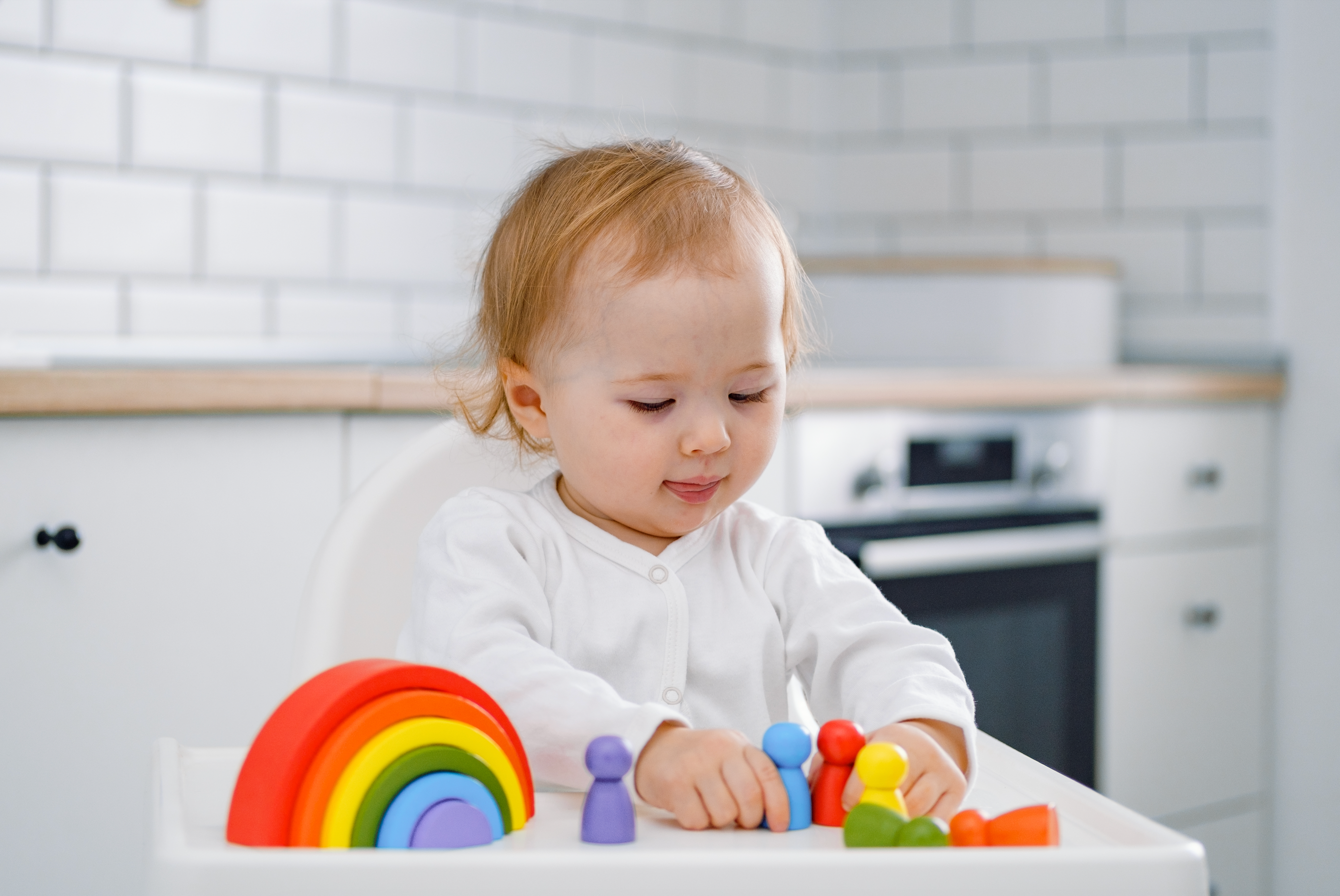
The wooden rainbow is a Montessori playroom classic because it is never the same toy twice. Suitable from 12 months, the nesting arches become a tunnel, a fence, a bridge, a set of cradles for small figures, or simply a tower to build and topple.
This is open-ended play at its most useful: the child decides what it is, and the toy quietly follows. It is one of the few pieces on this list that a one-year-old and a five-year-old will each find their own way to enjoy.
3. Toddlers Wooden Rocket Stacking Toy

A stacking toy in disguise: this rocket-shaped set gives a toddler from around 12 months the same grasp-and-stack practice as our classic stacking rings, with a shape that gives the play its own little story.
Building the rocket up piece by piece, then knocking it down to start again, is exactly the kind of repetition a young toddler seeks out on their own, no encouragement required.
4. Toddlers Wooden Bear Puzzle

A chunky, single-image puzzle is often a toddler's first real puzzle, and this bear design suits that first attempt well from around 18 months. Large, easy-to-grip pieces mean the challenge is in the matching, not in the fiddling.
Lifting a piece out and finding its place again builds the pincer grip and shape recognition that more complex puzzles, like our Animal Puzzle 6-pack, will ask for next.
5. Toddlers Wooden Animal Puzzle 6-pack

Six small wooden puzzles, each a different animal, suit toddlers from around 18 months up to five years. The pieces are chunky enough for a beginner and varied enough to keep a preschooler working, which is why the set stretches across such a wide age range.
Puzzles like these build fine motor control and problem solving, but the real gift is language. Naming the animals, making their sounds, talking about where they live: the puzzle becomes a conversation, and the vocabulary comes along for the ride.
6. Toddlers Geometric Shape Puzzle

For a toddler who has outgrown single-image puzzles, this geometric set steps things up with shapes to sort, match and place, and comes in a smaller and a larger piece count so you can match the challenge to your child. It suits children from around 2 years.
Working with pure shapes rather than pictures is quietly demanding: there's no bear's face to hint at the answer, just the shape itself, which is exactly the kind of self-correcting challenge Montessori materials are built around.
7. Toddlers Wooden Fruits & Vegetables Set

This set of realistic wooden produce is made for pretend play and is recommended for children aged three and over, as the pieces are small. Children slice, sort, cook and serve, folding the everyday rhythms of your kitchen into their own play.
Montessori leans gently towards real life, and food play is a natural bridge to it. As your child names each fruit and vegetable and copies what they see you do, they are building language and the first sense of doing things for themselves.
8. Toddlers Memory Game

The oldest pick here, this wooden matching game suits children from three years. Turn the pieces face down, take turns lifting two at a time, and try to remember where each pair is hiding.
It asks a little more of a child than the others: sitting still, waiting for a turn, holding a picture in mind. Those are big skills for a small person, and they arrive quietly through a game that simply feels like time spent together.
What makes a toy truly Montessori?
A toy is Montessori when it hands the thinking back to the child. It usually does one clear thing, it is made from natural materials your child can trust, and it has a built-in way of showing whether it worked, so a grown-up does not have to hover and correct.
Wooden toys fit this so naturally because they are honest. A wooden ring is heavier than a plastic one, it does not do anything on its own, and it invites your child to be the one who acts. If you would like the fuller picture, we wrote more about why wooden toys are a parent's best friend, and if you're weighing up wooden picks against other well-known names, see how we compare in our honest look at Montessori toy brands.
Are wooden Montessori toys safe, and do they last?
Yes: a well-made wooden Montessori toy is sanded smooth with no sharp edges, finished in a non-toxic, child-safe paint or oil, and sized appropriately so nothing is a choking hazard for the age it is sold for. Solid wood also resists the daily wear a toy box gets, so a well-built piece can survive years of play and still be handed down to a younger sibling or another family, rather than cracking or fading the way a thinner plastic toy often does.
What to check before you buy: a finish described as non-toxic or food-safe, edges that are rounded rather than cut sharp, and a weight that feels solid rather than hollow. Every wooden toy in our Montessori Wooden Toys collection is chosen against that same standard, which is also why they tend to outlast the stage they were bought for.
How do you choose the right wooden toy for your toddler's age?
Match the toy to what your child is working on right now, not to a number on a box. Around 12 months, look for grasping and stacking. Between 18 months and three years, simple puzzles and pretend play come alive. From three, games with turns and memory begin to hold their attention.
When in doubt, choose the slightly simpler toy: a child grows into open-ended play far more happily than they grow out of something that does too much for them. For a full walk-through, see our guide to choosing Montessori toys by age.
Common questions
What is a good first wooden Montessori toy for a one-year-old?
Start with something to grasp, stack and sort, such as the Stacking & Nesting Rings, the Rainbow Toy or the Wooden Rocket Stacking Toy. All are recommended from 12 months and give a young toddler independent, no-wrong-answer play.
Are wooden toys better than plastic for toddlers?
For open-ended, Montessori-style play, wood has real advantages: it is durable, made from a natural material, and it does not light up or make decisions for your child. That leaves your toddler to lead, which is the whole point.
What age are these wooden Montessori toys for?
The picks in this guide span 12 months to around five years. The Stacking Rings, Rainbow Toy and Rocket Stacking Toy start at 12 months, the Bear Puzzle from 18 months, the Animal Puzzle suits 18 months to five years, the Geometric Shape Puzzle from 2 years, and the Fruits & Vegetables Set and Memory Game are recommended from three years.
Which wooden toy grows with a child the longest?
The Rainbow Toy. Its open-ended shape means a one-year-old and a five-year-old each find a different way to play with it, so it stays on the shelf for years rather than months.
Are wooden Montessori toys worth the extra cost over plastic?
For many families, yes: a well-made wooden toy tends to last through several stages and can be handed down, rather than being outgrown or broken within weeks. That said, what makes a toy worth buying is its design, open-ended, self-correcting, age-appropriate, more than the material alone.
Are wooden toys more educational than plastic toys?
Not automatically; a toy's educational value comes from its design, not its material. But wood does offer natural weight and tactile feedback that suit Montessori-style learning well, which is why so many genuinely Montessori-aligned toys, including all eight here, happen to be made from it.
Every toy here lives in our full Montessori Wooden Toys collection, ready to find a place on your child's shelf and, with any luck, a place in the memories you are quietly building together.
With love from the Montessori Toddlers team 💛