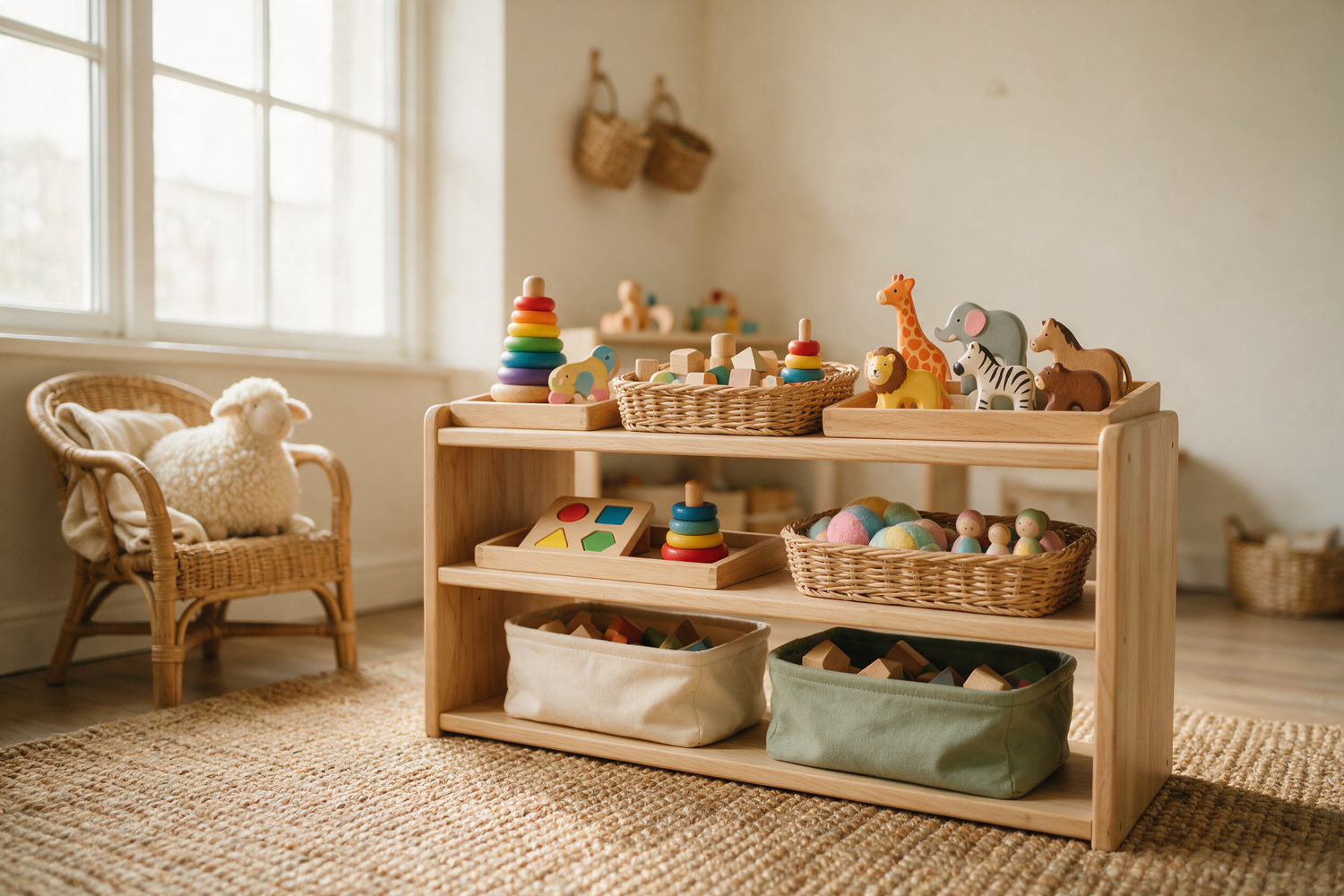
Once you start looking, "Montessori shelf" photos are everywhere: a few carefully spaced toys on a low wooden shelf, nothing overflowing, nothing plastic and blinking. It looks lovely, but it can also feel like one more thing to get right. The good news is that the idea behind it is simple, and you almost certainly already have what you need to start.
What actually makes a shelf "Montessori", and do I need to buy a special one?
Any low, open-fronted shelf at your child's height works, it does not need to be branded "Montessori" or bought from a specific store. What matters is three things: your child can see and reach everything without help, there are no doors or bins to dig through, and the shelf itself (and what's on it) is made from natural, honest materials rather than a jumble of loud plastic. A basic bookshelf, a repurposed sideboard with the doors removed, or a simple cube shelf all work just as well as a purpose-built one.
How many toys should actually be out at once?
Most Montessori guidance converges on around five to eight items for a toddler, and fewer for a baby who is just starting to explore. The point isn't the exact number, it's giving your child room to actually focus on one thing at a time instead of scanning a pile for the shiniest option. If this is new to you, our full guide to toy rotation covers how many toys to keep in circulation and how often to swap them.
What goes on the shelf, by age and stage
| Age range | Shelf height | What to put out | Example materials |
|---|---|---|---|
| 6-12 months | Floor-level, within arm's reach while sitting | 2-3 simple cause-and-effect toys | Object Permanence Box |
| 12-18 months | Low shelf, standing height | 3-4 toys with one clear purpose each | Stacking & Nesting Rings |
| 18-30 months | Shelf at eye level when standing | 4-6 toys, mixing puzzles and building | Wooden Bear Puzzle |
| 2.5-4 years | Standard low shelf, two tiers if possible | 5-8 toys, including something personal | Personalized Wooden Puzzle |
How to actually arrange the shelf
Arrange left to right, simplest to most complex, the way a classroom shelf is usually set up. Give each activity its own tray or basket rather than letting pieces mix together, a toddler is far more likely to finish a puzzle if the pieces are contained in one shallow tray than if they're loose next to three other things. Leave visible gaps between activities rather than lining them up edge to edge; a crowded shelf reads as clutter even with only six items on it.
What to actually put on it

For the youngest end of this range, an Object Permanence Box is a genuine one-purpose activity: drop the ball in, watch it disappear, then find it again. It's a small, contained win that a baby can repeat on their own.

As grasping and balance develop, Stacking & Nesting Rings add a size-sequencing challenge, a toy that quietly corrects itself when a ring goes on in the wrong order.

A simple puzzle like our Wooden Bear Puzzle builds fine motor control and problem-solving, and works well as one of the "focus" activities further along the shelf, away from anything too stimulating.

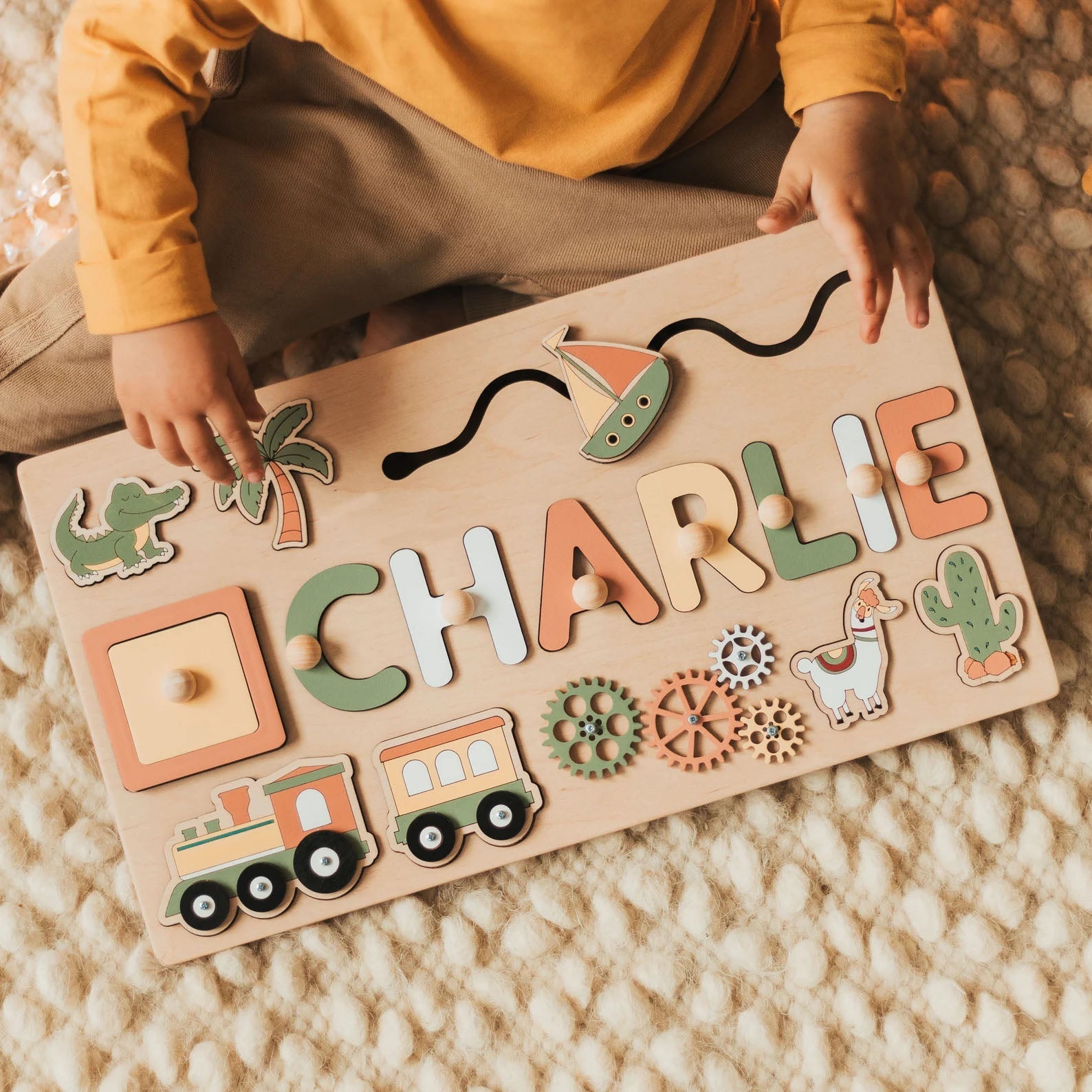
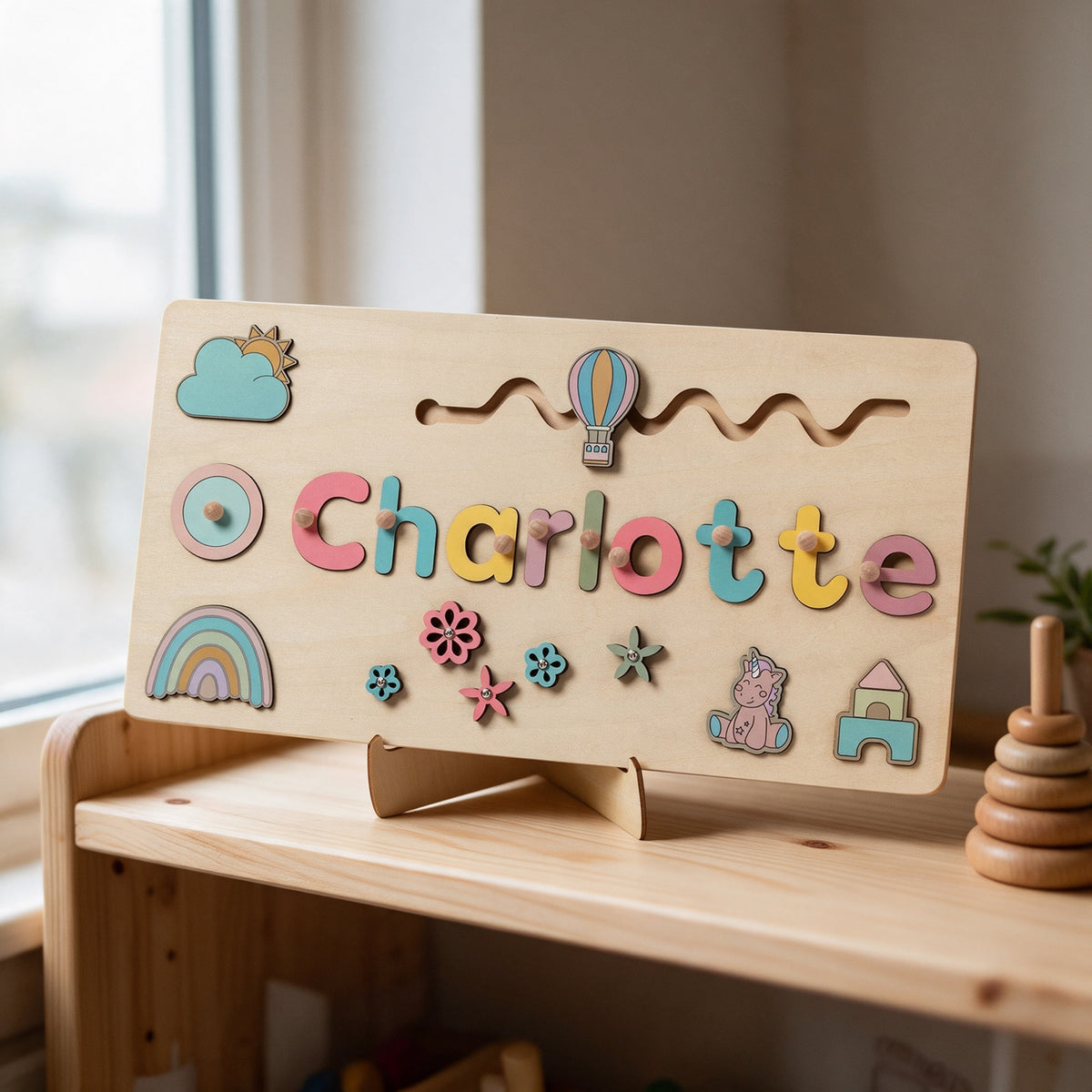
Once your child is a little older, something personal earns its place too. Our Personalized Wooden Puzzle, made to order with their own name, gives a shelf one item that's unmistakably theirs, which is often the one they return to again and again.

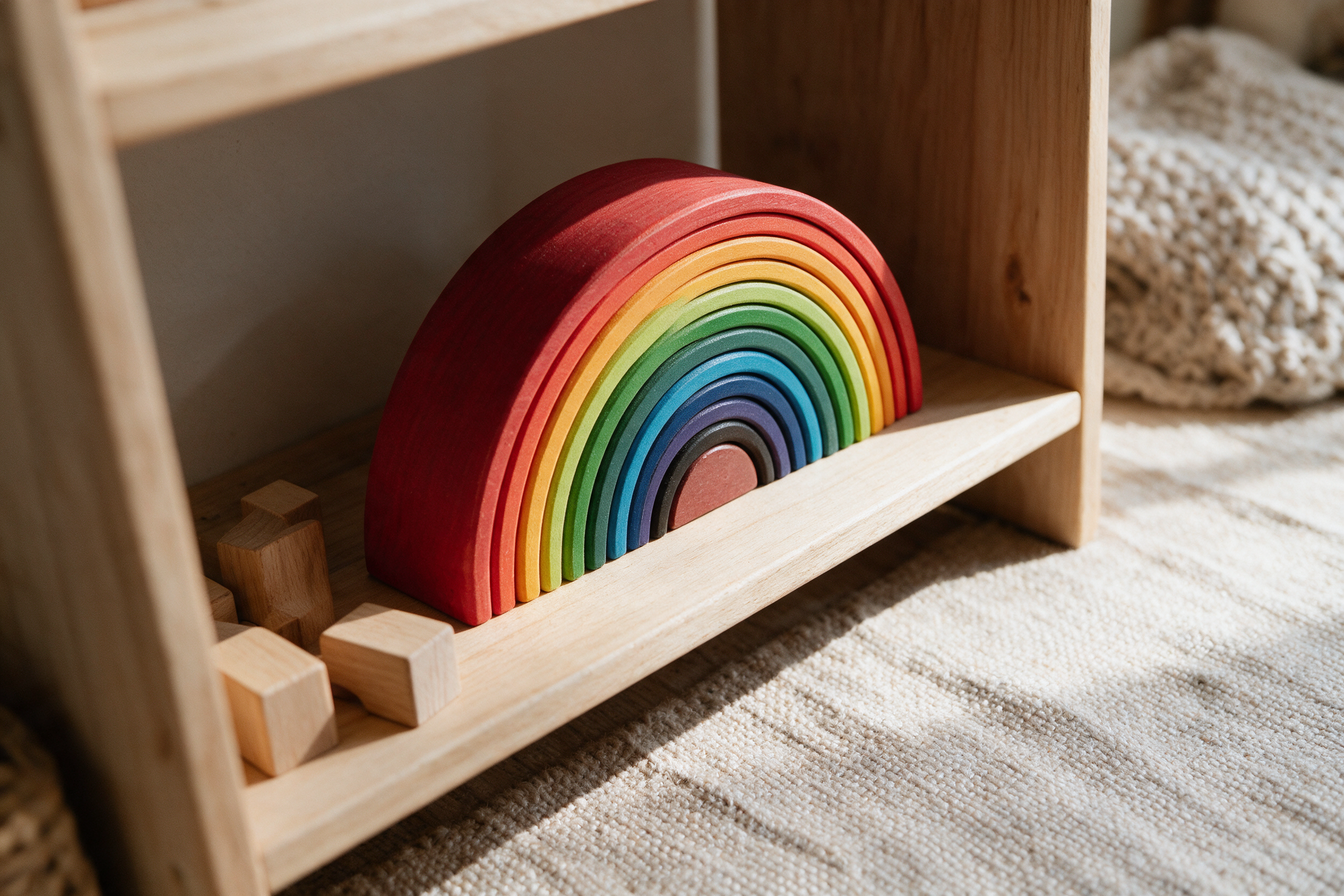
Rounding out the shelf with something more open-ended, like our Rainbow Building Blocks, gives your toddler somewhere to be creative once the more purposeful activities are done. If you'd rather have someone else choose a full age-matched set for you as a one-off purchase, our guide comparing subscription boxes to one-off Play Kits can help you decide which approach suits your family before you build the shelf yourself.
Frequently asked questions
Does a Montessori shelf need to be a special brand?
No. Any low, open-fronted shelf your child can reach and see into works. The label doesn't matter; the height, openness and simplicity do.
How many toys should be on a toddler's shelf?
Most guidance suggests five to eight items for a toddler, and fewer for a baby. The goal is focus, not a full shelf.
What height should a Montessori shelf be?
Low enough that your child can see and reach every item without asking for help, usually somewhere between floor level for a baby and standing eye height for an older toddler.
Do I need trays and baskets?
They help. Containing each activity in its own tray or basket keeps pieces from mixing and makes a toy easier for a child to finish independently, but a shelf with no trays at all is still better than a toy box.
How is this different from just tidying up toys?
Tidying is about storage; a Montessori shelf is about deliberate choice, fewer toys, each with a clear purpose, arranged so your child can choose and put away independently rather than dig through a bin.
With love from the Montessori Toddlers team 💛