The first year moves impossibly fast. One month your baby can barely track a face across the room, and by their first birthday they are pulling themselves up to standing and posting things into every gap they can find. Montessori toys for this stage do not try to rush any of it. They simply meet a baby exactly where they are, one skill at a time.
Below is a gentle, age-by-age gift guide for a baby's first twelve months, with a few thoughtfully made toys we would genuinely give as a gift ourselves.
What makes a Montessori toy right for a baby's first year?
A good Montessori toy for a baby's first year does one simple thing well, uses natural or soft, safe materials, and asks nothing of the child except to explore. There are no batteries, no flashing lights, and no "correct" way to play. A book that only crinkles, a ball that only disappears and reappears, a ring that only stacks, that is more than enough for a brain that is building itself from scratch, and it is far calmer for parents too.
Our picks at a glance
| Toy | Suitable age | Develops | Best for |
|---|---|---|---|
| Toddlers Soft Books | 0–6 months+ | Sensory exploration, early visual tracking | First tactile play and bedtime stories |
| Toddlers Object Permanence Box | 6 months+ | Object permanence, cause and effect, hand-eye coordination | Understanding "gone but not really gone" |
| Toddlers Baby Beehive | 6 months+ | Pincer grip, sorting, self-recognition | Repeatable open-and-discover play |
| Toddlers Stacking & Nesting Rings | 12 months+ | Grasp, release, multi-sensory exploration | A first-birthday stacking milestone |
0 to 6 months: the first sensory adventures
In the earliest months, a baby is mostly taking the world in through their eyes, hands and ears, so the simplest sensory toys do the most good. Our Toddlers Soft Books are designed for exactly this stage, filled with crinkle paper and soft, safe textures for little hands to squeeze and explore, with a story to listen to along the way.

They are washable and travel well, so they end up doing double duty as a stroller toy and a bedtime ritual. See the Toddlers Soft Books →
6 to 12 months: object permanence and first grasp
Somewhere around six months, babies discover one of their first big ideas: that a thing which disappears from view has not actually vanished. Our Toddlers Object Permanence Box turns that discovery into a game, dropping a wooden ball through the hole, watching it go, and finding it waiting in the tray below.

It is quiet, screen-free, and endlessly repeatable, which is exactly what a baby this age wants from a toy. See the Toddlers Object Permanence Box →
The same months bring the beginnings of the pincer grip, the careful thumb-and-finger pinch that will later hold a spoon and a pencil. Our Toddlers Baby Beehive gives them a reason to practise it: five soft bees to pull out of a plush hive, post back through the little door, and find waiting in the mirror inside.

It squeaks, rattles and crinkles, so every small movement earns a small reward. See the Toddlers Baby Beehive →
Approaching 12 months: the first real stacking challenge
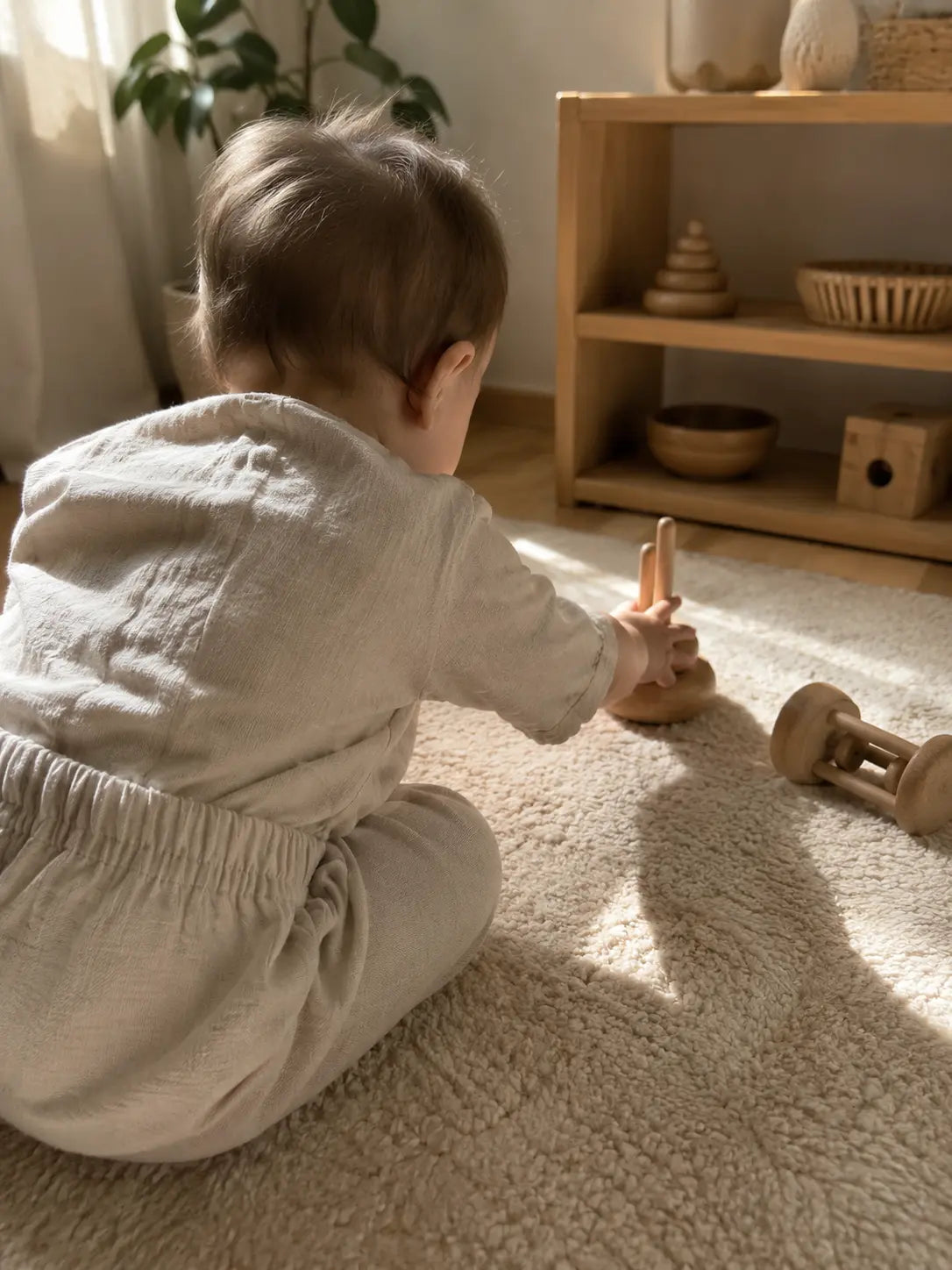
Right around their first birthday, a baby's grasp shifts from an open-handed swipe to a deliberate, controlled pinch, and stacking becomes possible for the first time. Our Toddlers Stacking & Nesting Rings is designed for exactly this turning point, with eight pieces across six different textures, beechwood, silicone, plush and fabric, so lifting, balancing and knocking the tower down all feel different in tiny hands.

It is a lovely one to have ready and waiting as a first birthday gift, one they will keep returning to well into their second year. See the Toddlers Stacking & Nesting Rings →
How many toys does a baby actually need?
Far fewer than the average nursery shelf suggests. A baby's attention is not held by quantity, it is held by having a small number of toys within reach and the calm, unhurried time to explore each one properly. Many Montessori parents rotate: a handful of toys out at a time, the rest put away and brought back later like new. A baby with one soft book, one cause-and-effect toy and one grasping toy to properly master is better served than one surrounded by twenty.
Frequently asked questions
When can babies start with Montessori toys?
From birth. Even a newborn benefits from simple sensory input like a soft book or a gentle rattle, and Montessori toys simply grow in complexity alongside the baby.
Do babies need wooden toys specifically?
Not exclusively. Natural materials like wood are lovely for their weight and texture, but soft plush and fabric toys matter just as much in the first year, especially for the safe mouthing and cuddling babies need.
How many toys should be out at once for a baby?
A handful is plenty. Two or three toys, chosen for the stage your baby is at, hold their attention far better than a full basket ever will.
If you would like to browse everything suited to this stage in one place, our 0-12 Months collection gathers our full range for a baby's first year.
With love from the Montessori Toddlers team 💛